





Every tattoo fades over time — but the rate of fading depends largely on how you care for your ink. Understanding what actually causes tattoo fading, at a biological level, helps you take the right steps to keep your tattoos looking bold and vibrant for decades instead of years.
1. Sun Exposure — The Biggest Culprit
UV rays are the single most damaging factor for tattoo longevity, and the mechanism is worth understanding. Tattoo ink sits in the dermis — the second layer of your skin, just beneath the epidermis. UV radiation penetrates the epidermis and reaches the dermis, where it breaks down ink pigment molecules at a molecular level. Both UVA and UVB rays contribute, and the damage accumulates silently over time, even on cloudy days, since up to 80% of UV radiation passes straight through cloud cover.
Not all colours fade at the same rate under UV exposure. Reds and yellows are especially vulnerable and tend to visibly dull years before blacks and blues, which is why a tattoo can start to look ‘off’ in specific colours long before the whole piece looks faded.
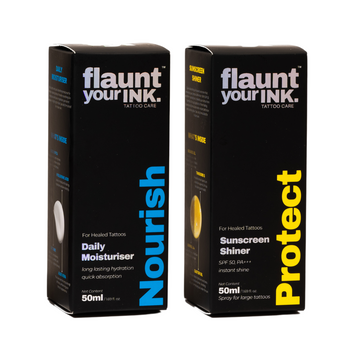
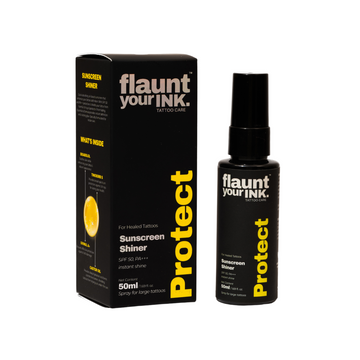
Prevention: Apply SPF 50 broad-spectrum tattoo sunscreen daily before going outdoors. Reapply every 2-3 hours during extended exposure.
2. Dry Skin
Dehydrated skin makes tattoos look dull, faded, and lifeless — even when the ink itself hasn’t actually broken down. When skin loses moisture, the surface becomes flaky and rough, which scatters light instead of reflecting it cleanly off the ink underneath.
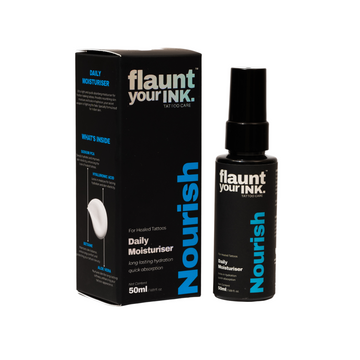
Prevention: Use a daily tattoo-specific moisturiser, not a generic body lotion. Tattoo moisturisers are formulated without ingredients — like certain acids or retinoids — that can accelerate ink breakdown.
3. Poor Aftercare During Healing
The first 2-4 weeks after getting tattooed are the most consequential for how the tattoo will look for the rest of its life. During this window, your immune system is actively working on the fresh wound — white blood cells called macrophages arrive to help clean up the area, and in the process they can carry away ink particles that haven’t fully settled into the dermis yet. Infections, excessive scabbing, or picking at peeling skin accelerate this ink loss, leading to patchy, uneven fading.
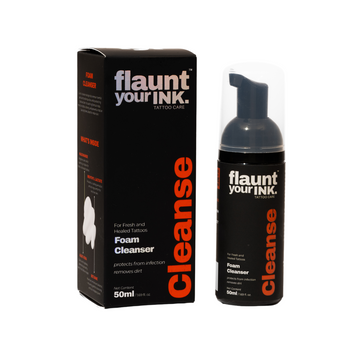
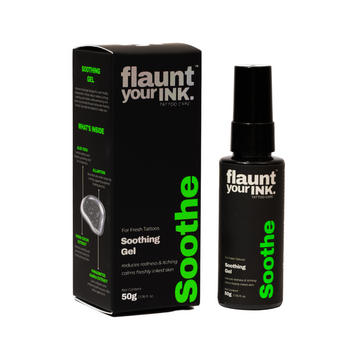
Prevention: Follow a proper aftercare routine with a gentle cleanser and healing gel from day one, and never pick at scabs or peeling skin.
4. Friction and Abrasion
Tattoos in areas that experience constant friction — waistbands, bra straps, the inside of wrists, shoes — fade noticeably faster than tattoos in low-friction areas, because repeated mechanical rubbing acts like a slow, continuous exfoliation.
Prevention: Keep high-friction areas well-moisturised, and consider this when planning placement for future tattoos.
5. Tattoo Quality and Ink Depth
Shallow ink application or low-quality inks fade dramatically faster than ink deposited correctly into the dermis. An inexperienced artist may apply ink too close to the surface, or use inconsistent pressure that leaves some areas under-inked.
Prevention: Research your artist before booking — look at healed photos, not just fresh ones.
6. Aging
As skin ages, it naturally loses collagen and elasticity, which changes how the dermis holds ink over decades. This is slower and more gradual than the other five factors, but it’s part of why the same tattoo looks different on the same person 20 years apart, even with identical aftercare.
Prevention: There’s no way to stop skin aging, but keeping skin generally healthy — hydrated, sun-protected, well-nourished — slows how much this factor affects your tattoo specifically.
The Bottom Line
You cannot prevent all fading — it’s a natural part of how skin and ink interact over a lifetime. But you can dramatically slow it down. A simple daily routine of moisturising and applying sunscreen addresses the two biggest, most controllable causes on this list, and keeps your ink vibrant for years longer than an unprotected tattoo.
For a deeper look at maintaining tattoos over the long run, see our full guide on keeping old tattoos looking new.
Frequently Asked Questions
How long does it take for a tattoo to start fading?
It varies widely by ink quality, placement, and care, but most tattoos show some visible softening within 5-10 years without proper sun protection and moisturising. With consistent care, that timeline extends significantly — sometimes decades.
Do all tattoo colours fade at the same rate?
No. Reds and yellows are generally the most UV-sensitive and tend to fade first. Black and blue ink typically holds its depth the longest.
Can a faded tattoo be restored?
Yes, in most cases. A touch-up session with your original artist, or an experienced artist if the original isn’t available, can restore colour and sharpen blurred lines.
Is tattoo fading a sign of a bad tattoo?
Not necessarily. All tattoos fade to some degree over time — it’s a natural biological process. Fast, uneven, or patchy fading is more often a sign of insufficient aftercare or UV protection than of poor technique, though ink depth from the original application does play a role.